《The sanitation in restrooms to respiratory health: modelling concentration distribution changes of bioaerosols across buildings with/without semi-open settings》
Website: https://doi.org/10.1016/j.envpol.2025.127283
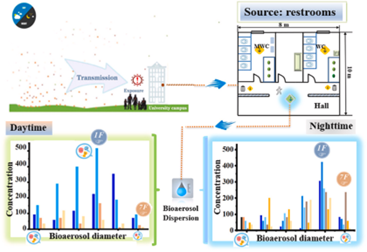
Graphical Abstract:
ABSTRACT:
The sanitation of buildings raises concerns due to pathogen release from restrooms. Herein, bioaerosol pollution profiles from buildings' public restrooms with/without semi-open settings were comparatively analyzed in two cities of China. For the GD building in Southern China with semi-open setting restrooms, the cultivable microbial concentration (Cbio) peaked on 2.1–3.3 μm particles (483–1107 CFU/m3) during the evening with high RH (90 %). Furthermore, the lower the floor, the higher the Cbio on 2.1–3.3 μm particles. For the LN building in Northern China without semi-open setting restrooms, the Cbio peaked on 1.1–2.1 μm particles (554–907 CFU/m3) during the evening with low RH (20 %). What's more, Cbio was also high (212–389 CFU/m3) on the finest particle (0.65–1.1 μm). However, the Cbio on each particle size was the highest at the 1st-floor for both buildings. Furthermore, the bioaerosol abundances of the genera Sphingomonas, Bacteroidetes, Pseudogracilibacillus, Cerasibacillus, Escherichia Shigella, Curvularia, and Aspergillus diffused in restrooms' air. In the >4.5-m corridor to restrooms, airborne Staphylococcus epidermidis, Staphylococcus aureus, Bacillus amyloliquefaciens, and Aspergillus fumigatus were abundant along the passages. A mathematical model showed that breathing in 0.65–3.3 μm bioaerosols from restrooms dispersing to outdoor architectural complexes increased health risks. A wind tunnel test explicated that 0.2–2.5 m/s winds of 65 %–90 % RH in the GD building increased 0.3–1.5 m horizontal diffusion concentration gradients of deposited cultivable Escherichia coli bioaerosols. The modeling highlights the airborne bio-pollutant diffusion-induced inhalation risks from sanitation systems in southern and northeastern cities.

