《Response and Formation Mechanism of Highly Antibiotic-Resistant Dormant Subpopulations in Bioaerosol during Aerosolizing from Aquatic Environments》
Website: https://pubs.acs.org/doi/10.1021/acs.est.5c06017
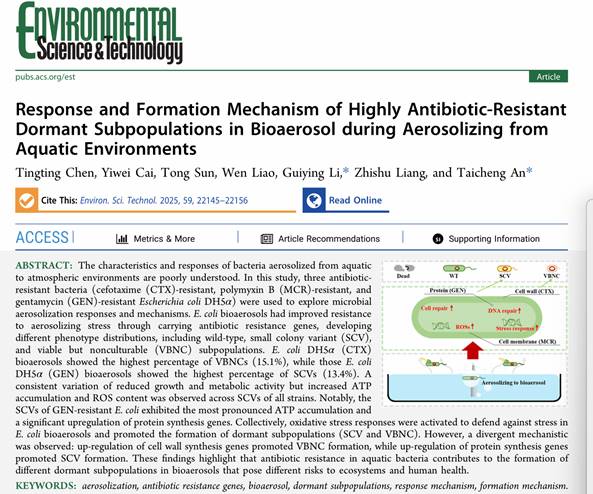
Graphical Abstract:

ABSTRACT:
The characteristics and responses of bacteria aerosolized from aquatic to atmospheric environments are poorly understood. In this study, three antibiotic-resistant bacteria (Escherichia coli DH5α (CTX), E. coli DH5α (MCR), and E. coli DH5α (GEN)) were used to explore microbial aerosolization responses and mechanisms. E. coli bioaerosols had improved resistance to aerosolizing stress through carrying antibiotic resistance genes, developing different phenotype distributions, including wild-type, small colony variant (SCV), and viable but non-culturable (VBNC) subpopulations. Cefotaxime (CTX)-resistant E. coli bioaerosols showed the highest percentage of VBNCs (15.1%), while those gentamycin (GEN)-resistant E. coli bioaerosols showed the highest percentage of SCVs (13.4%). Lower growth capacity, reduced metabolic activity, increased adenosine triphosphate accumulation, elevated intracellular reactive oxygen species, up-regulated protein synthesis-related genes, and enhanced gentamicin resistance were observed in GEN-resistant E. coli SCVs. Oxidative stress responses were activated to defend against stress and promoted the formation of dormant subpopulations. Up-regulation of cell wall synthesis genes promoted VBNC formation, while up-regulation of protein synthesis genes promoted SCV formation. These findings highlight that antibiotic resistance in aquatic bacteria contributes to the formation of different dormant subpopulations in bioaerosols that pose different risks to ecosystems and human health.

