《Enhanced transformation mechanisms of antibiotic resistance genes in water under the stress of sub-lethal photocatalysis》
Website:https://www.maxapress.com/article/doi/10.48130/biocontam-0025-0017
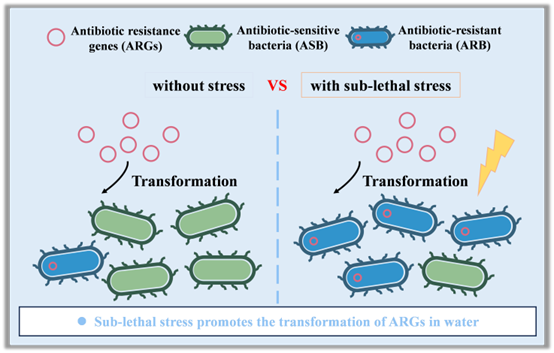
Graphical Abstract:
ABSTRACT:
The spread of antibiotic resistance genes (ARGs) in aquatic environments has attracted considerable attention. Transformation is one form of horizontal gene transfer. Bacteria may be subject to sub-lethal stress in the environment, but the impact of sub-lethal stress on ARG transformation and related mechanisms remains unclear. In this study, sub-lethal photocatalysis (sub-PC) was employed to simulate the condition of incomplete water disinfection. Two antibiotic-sensitive bacteria (ASB) (E. coli DH5α and E. coli HB101) were selected as recipient bacteria, combined with the pUC19 plasmid carrying the ampicillin resistance gene (amp), to build different transformation systems, aiming to investigate the impact of sub-lethal stress on the transformation of ARGs. Meanwhile, by detecting the physiological characteristics of recipient bacteria, before and after sub-PC treatment, this study reveals the mechanism of ARG transformation under sub-lethal treatment. The results show that sub-PC treatment increased the transformation frequency of the amp gene by 3.0-4.5 times. Upon exposure to sub-lethal stress, nearly 10% ASB (as recipient strains) remained viable, providing the basis for ARG transformation. Concurrently, the intracellular reactive oxygen species (ROS) levels in ASB increased, reaching the highest level 3-4 times. The antioxidant stress system was also activated, as evidenced by increased levels of CAT and SOD. Furthermore, bacterial membrane permeability was validated, and intracellular Ca2+ accumulation was observed in bacterial cells (the highest increase reaching nearly four times). These are all the reasons why the transformation frequency of ARG increased in the aquatic environment. Moreover, the decrease in intracellular ATP content indirectly facilitated the occurrence of ARG transformation by causing intracellular Ca2+ accumulation. Detection of the expression of the related gene also confirmed these findings. In summary, exposure to sub-lethal stressors in bacteria promotes the transformation of ARGs, thereby increasing the risk of spread of antibiotic-resistant bacteria (ARB) in aquatic environments. The results obtained in this work contribute to a better understanding of the dissemination of ARGs in aquatic environments.

