《Anisotropic Strain-Induced Piezoelectric Polarization in 3R-MoS2 for Enhanced Piezo-Photocatalytic Oxidation of Formaldehyde》
Website: https://doi.org/10.1002/adfm.202528763
Graphical Abstract:
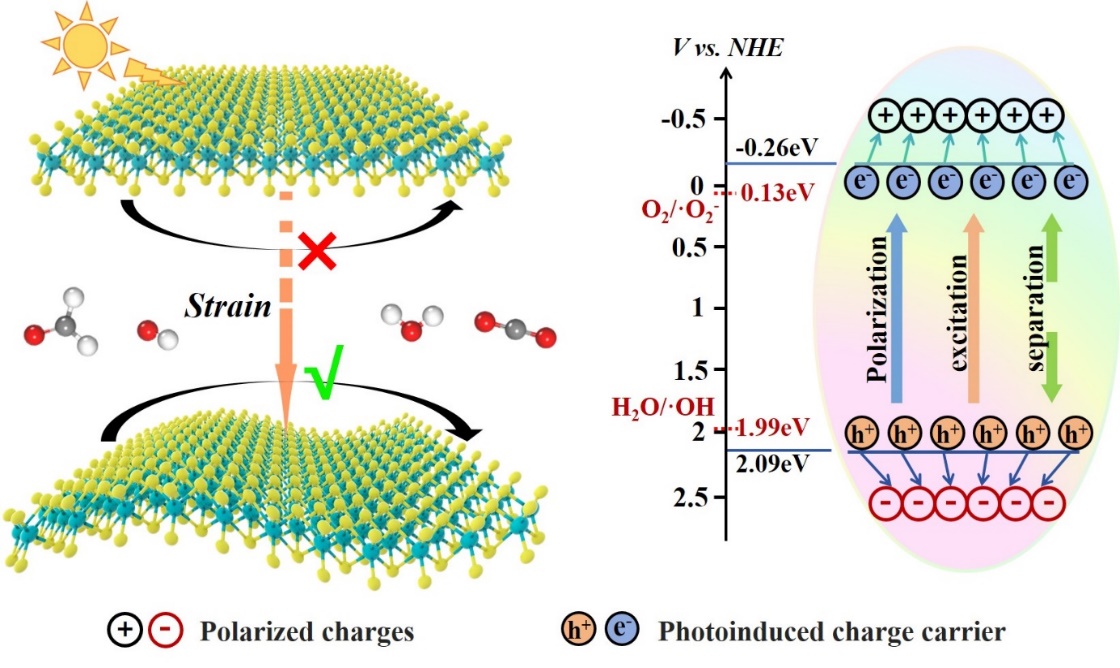
ABSTRACT: The efficient removal of formaldehyde (HCHO), a pervasive and hazardous atmospheric pollutant, remains challenging due to inherent limitations in conventional photocatalysis, particularly rapid charge recombination and insufficient reactive oxygen species (ROS) generation. Although the non-centrosymmetric structure of sliding ferroelectric 3R-MoS2 enables piezoelectric polarization to overcome these constraints, the atomistic origin of how this anisotropic strain-induced polarization modulates surface reaction kinetics is not well understood. Herein, we develop a first-principles piezoelectric polarization model and integrate it with experimental validation to unravel the atomic-scale piezo-photocatalytic mechanism of 3R-MoS2 for HCHO degradation. Our results demonstrate that anisotropic compressive strain along the armchair direction induces strong piezoelectric polarization via asymmetric Mo-S displacements, while zigzag-oriented strain produces negligible response. Experimental characterization confirms the successful synthesis of the non-centrosymmetric 3R-MoS2 and its pronounced anisotropy. The tailored polarization establishes an internal electric field that simultaneously optimizes band structure and aligns with critical redox potentials for efficient charge separation. Remarkably, -6% armchair polarization reduces the energy barrier of the rate-determining step by 92% through interfacial charge redistribution and d-band center upshift. Experimental validation confirms a twofold catalytic enhancement in 3R-MoS2 over the 2H-phase. This work elucidates strain-directed piezo-photocatalytic HCHO oxidation and paves the way for noble-metal-free environmental remediation.

